
One partner.
Your entire Canton Network lifecycle.








Everything it takes to go live on Canton, in one place.

Node Infrastructure
Validator nodes deployed and operated through CatalyX Blockchain Manager, on your cloud or ours. Your nodes stay yours, and you can take operations in-house at any time.
Super Validator Operations & Weight Hosting
Already a Super Validator (SV), or working toward it? We run full SV operations on the Global Synchronizer, including SV weights hosting and support the path itself with governance positioning and CIP drafting.
Wallet & Custody Connectivity
Your chosen wallet and custody providers, integrated, with qualified custody preserved end-to-end.

Application Development & Distribution
Daml applications designed and built using IntellectEU’s engineering expertise. Then packaged and distributed through CatalyX Package Manager.
Custom Services on Demand
Tokenomics, CIP drafting, governance positioning, Canton and Daml architecture review.

On-chain / Off-chain Orchestration
Canton Network connected to your back office, custody, and compliance pipelines through CatalyX Orchestration Manager.
Support
24/7 coverage across regions and time zones. Performance and liveness monitoring across your validators. Ongoing alignment with Canton protocol changes and CIPs. Dedicated escalation paths with custom SLAs up to 99.9%.
As covered by Business Insider: IntellectEU launches Canton Onboarding Package to streamline DTCC pilot participation.
Canton Insiders













https://youtu.be/WL92cIeIDvQ
https://open.spotify.com/episode/3GPXo756byruCCX5EnUPGz
https://youtu.be/zAcB5Vj0s4A
https://open.spotify.com/episode/4mb5BCk0PMBRZzW5O4fr19
https://youtu.be/o_SqbqLK4S8
https://youtu.be/BQozkRlPnoI
https://open.spotify.com/episode/7sYzcnS4viVzLS6D6JU4uU
https://youtu.be/SJhLfCY7RpU
https://open.spotify.com/episode/0Kib9vofFuZ89P2fioLVH0
https://youtu.be/87R98QAUngw
https://open.spotify.com/episode/2NUujfahoaPxBNxZjWMmb4
https://youtu.be/OpEKSGooK8c
https://open.spotify.com/episode/6xg89KSGPwnhUxnMCWEOjC
https://youtu.be/p7rQOhEn66k
https://open.spotify.com/episode/70owMW5hBLg8AKZfc1m4HP
https://youtu.be/NTOZOSAb59M
https://open.spotify.com/episode/33gJgGxn1UNfzZ4czUChpu
https://youtu.be/BWsd2hXZpU8
https://open.spotify.com/episode/3G0jIKSBrx6CHtvCNbzWOv
https://youtu.be/MoknmKdMcQI
https://open.spotify.com/episode/5nMjHxhN2S2YVgUytcZTAk
https://youtu.be/yr6l5s3BKew
https://open.spotify.com/episode/56mjtbqptnatLPLvLYqunQ
https://youtu.be/INE2ddz7lLs
https://open.spotify.com/episode/5DN4AptvayG42gz1rh4frM
https://youtu.be/8wGIy1mstn8
https://open.spotify.com/episode/025gw3DEjPPLLjbfVCt3oj
https://youtu.be/rz0zclvCEXg
https://open.spotify.com/episode/0fc5DRFiSspkfY8iV5kuFG
https://youtu.be/9o7eQWiPcPs
https://open.spotify.com/episode/5USaOB3ZFP1oQG6WzBXXlC
Built by the team that has run Canton Network infrastructure and operations from the start.

CatalyX is the product suite by IntellectEU
A fintech integrator building for financial institutions for 20 years, working with blockchain and DLT since 2014
First Node-as-a-Service
provider on the Canton Network
100+
validators in production
10+
Canton applications brought to production
10+
years of DAML and Canton expertise
Founding Member
of the Canton Foundation. Super Validator and Super Validator Operator on Canton Network.

CatalyX allows your team to stay focused on the business outcome. The first conversation is not about nodes or applications. It is whether Canton makes sense for your business case.




What institutions already run in production with CatalyX & IntellectEU.
how-c7-runs-a-super-validator-and-two-canton-applications-on-one-platform
canton-validator-behind-brales-stablecoins
how-zenith-runs-the-evm-layer-for-canton-network
Canton Network is the first privacy-enabled open blockchain network, already chosen by Wall Street.
Private by design
A network of networks
Path to production
CatalyX by IntellectEU is your one partner for the entire Canton lifecycle. 10+ years of hands-on experience with Daml and Canton, a founding seat on the Canton Foundation, and 100+ validators under management.

$6T+
Tokenized assets
$350B+
Average daily repo volume
800+
Active validators



From use case to production in three steps.
Define the goal
Tell us what you want out of Canton. Bring specs, an early draft, or just the idea. We turn it into production requirements and give you a clear view on whether Canton fits your case.
Confirm the scope
Pick the blocks you need: nodes only, application only, or the full package. One agreement covers delivery, SLAs, and support.
Build and go live
Deploy validators, build and distribute the application, connect your existing systems, and go to production with 24/7 operations behind you.

Ready to go live on Canton?
.png)
Canton Network Coin: What Validators and Application Providers Actually Earn
Canton Network Coin: What Validators and Application Providers Actually Earn
The Canton Network is a public Layer 1 blockchain with configurable privacy. An institution that wants to hold assets, run an application, or settle transactions on Canton runs its own node. That node is a validator, and running one is the cost of entry.
Canton Coin (CC) is the network's utility token, and it pays for network capacity. Validators burn it to send traffic through the shared synchronization layer, and earn it back for the activity they contribute. That puts CC on both sides of the same ledger.
Does running a Canton Network validator pay for itself?
Not from rewards alone. Minting caps enforce an upper bound on the minted Canton Coin that can be claimed per unit of activity, ensuring that rewards remain anchored to legitimate network value rather than synthetic transaction volume. In the past, a validator could mint at most $0.20 of Canton Coin for every $1 of synchronizer traffic it burns, so the reward pool offsets a fraction of infrastructure spend rather than refunding it entirely.
The reward basis changed twice inside a year, which puts most guidance written before December 2025 out of date. What follows is what validators and application providers earn as of September 2026, what changed in April, and why next quarter's cost is still difficult to forecast.
What you pay to use Canton Network
Like most public blockchain networks, the Canton Network charges a fee for its use. Canton users pay two types of fees to use the Global Synchronizer (i.e., the network): synchronizer traffic fees and holding fees.
Synchronizer traffic fees are fixed at a certain amount of USD per MB of bandwidth, or "synchronizer traffic," that is needed to submit transactions. Although fees are quoted in USD, they are paid using the network's native utility coin: Canton Coin (CC). Currently, the price for 1MB of traffic on the Canton Network is $60 USD. CatalyX team has previously overviewed and explained Canton Network transaction fees.
How Canton Network rewards validators and application providers
Each minting round divides its issuance three ways: 62% to application providers, 18% to validators and 20% to Super Validators. A 5% Development Fund comes off the top first under CIP-0082, so the three reward pools share 95% of the maximum tranche. Rounds open every ten minutes, and each one publishes the parameters that govern it, including the USD to CC conversion rate that Super Validators set by median vote.
Within each pool, rewards are shared in proportion to recorded activity weight, and this is where the two participant types diverge. Validators earn weight from the synchronizer fees they burn, on the reasoning that paid traffic is a fair proxy for the useful work a node does. Application providers earn weight from the traffic their workflows generate, provided they hold featured status.
That second mechanism, CIP-0104, approved on 12 February 2026 and rolling out in stages since 2 March, replaced the older featured-app activity markers with reward weight measured directly from sequencer and mediator data. The markers had been over-claiming against traffic actually burned by roughly 150%. The same proposal has the mediator reimburse validators for protocol-conformant confirmation responses, which narrows a validator's real traffic cost toward the transactions its own users submit.
Why Canton validators no longer earn rewards for uptime
Validator liveness rewards were phased out during 2026 and set to $0 on 30 April, so keeping a node online no longer earns Canton Coin on its own. It is the most consequential change to Canton Network tokenomics this year.
Under CIP-0096, approved on 31 December 2025, the network measured its own exposure. Over the window from 8 November to 7 December 2025, roughly 70% of all minting from the validator reward pool came from liveness rather than activity, amounting to 132M CC. The stated rationale was the free-rider problem: a validator could collect uptime incentives indefinitely without contributing anything the network needed, and as the validator count grew, so did the cost of subsidizing availability that no longer needed a subsidy.
The cap came down in stages, from $3.33 to $2.50 to $0.60 before reaching zero, which gave operators a runway. Validators now earn through activity rewards only, in proportion to the fees they burn. A node that stays online without processing transactions earns nothing.
Do validator rewards cover the cost of traffic?
They cover at most a fifth of it. Validators can mint $0.20 of Canton Coin per $1 of eligible activity weight, and that cap almost always binds under normal network load, so $0.20 is the effective rate rather than a ceiling.
Set that against how weight is calculated. A validator's activity weight is the USD value of the traffic it burned, so burning a dollar earns back at most twenty cents, and additional volume does not change the ratio.
Traffic therefore belongs in the cost column, with rewards booked as partial recovery rather than revenue. Early business cases routinely model it the other way.
What does it cost to stay a featured application or Super Validator
Eligibility is now a capital commitment, and two recent proposals are the reason. Both are approved and rolling out in stages rather than fully in force, so confirm the current increment before planning against them.
Under CIP-0116, approved on 20 May 2026, a featured application must keep Canton Coin locked to hold its status: 5,000,000 CC per PartyId, rising to 25,000,000 CC for asset issuers, held in a segregated party disclosed to the Foundation. Falling below the threshold removes featured status immediately, with no grace period, and withdrawn collateral is released over 60 days at one sixtieth per day, which makes exiting a two-month process.
Under CIP-0105, approved on 2 March 2026, Super Validators face a comparable requirement calculated against aggregate lifetime earnings, beginning near 70% and stepping down toward 55% by the third year. Locking less than the required share drops the operator into a reduced weight tier, and weight that stays under-locked past the grace window is forfeited permanently.
Both requirements belong with whoever owns the balance sheet, which changes who needs to be in the room when an institution decides how far into the Canton ecosystem to go.
Why Canton Network costs are hard to forecast
Because your rewards depend on what the rest of the network does. Minting entitlements are shared in proportion to your activity weight against the total weight in the pool, so the same traffic can earn a different amount from one round to the next. The minting cap sets the ceiling, the rest of the network's activity sets where you land under it, and no participant can see that in advance.
The inputs move too. Traffic is priced in USD but settled in Canton Coin at a rate republished every ten minutes, the per-megabyte price changes by two-thirds Super Validator vote under CIP-0084, and the reward basis changed twice inside a year.
Canton estimates the cost of a single transaction natively. The aggregate view is the gap: The Tie, Coin Metrics, CantonScan and Lighthouse report it accurately, but only once it has happened. CatalyX Fee & Reward Manager is being built for the layer above - exposure aggregated across business lines, attributed to the teams that generated it, and coupons claimed before they expire. It is coming soon.
Planning Canton infrastructure economics?
CatalyX runs validator infrastructure and Canton operations tooling for institutions that need the numbers to hold up in front of a finance team. CatalyX Fee & Reward Manager, for aggregating Canton spend and tracking reward claims, is coming soon.
From Pilot to Production: Building on Canton Network for Tokenized Assets
DTCC's announcement on May 4 set a clear path. Limited production trades in July 2026. Full tokenization service launch in October 2026. More than fifty participants in the DTCC Industry Working Group are now moving from design discussions into operational reality.
This is what production actually asks of you. And how a one-stop operational layer answers it.
What changes between pilot and production
A pilot can run on a single validator with relaxed availability targets. A handful of test counterparties. One settlement workflow. Curated data.
Production tokenized assets cannot.
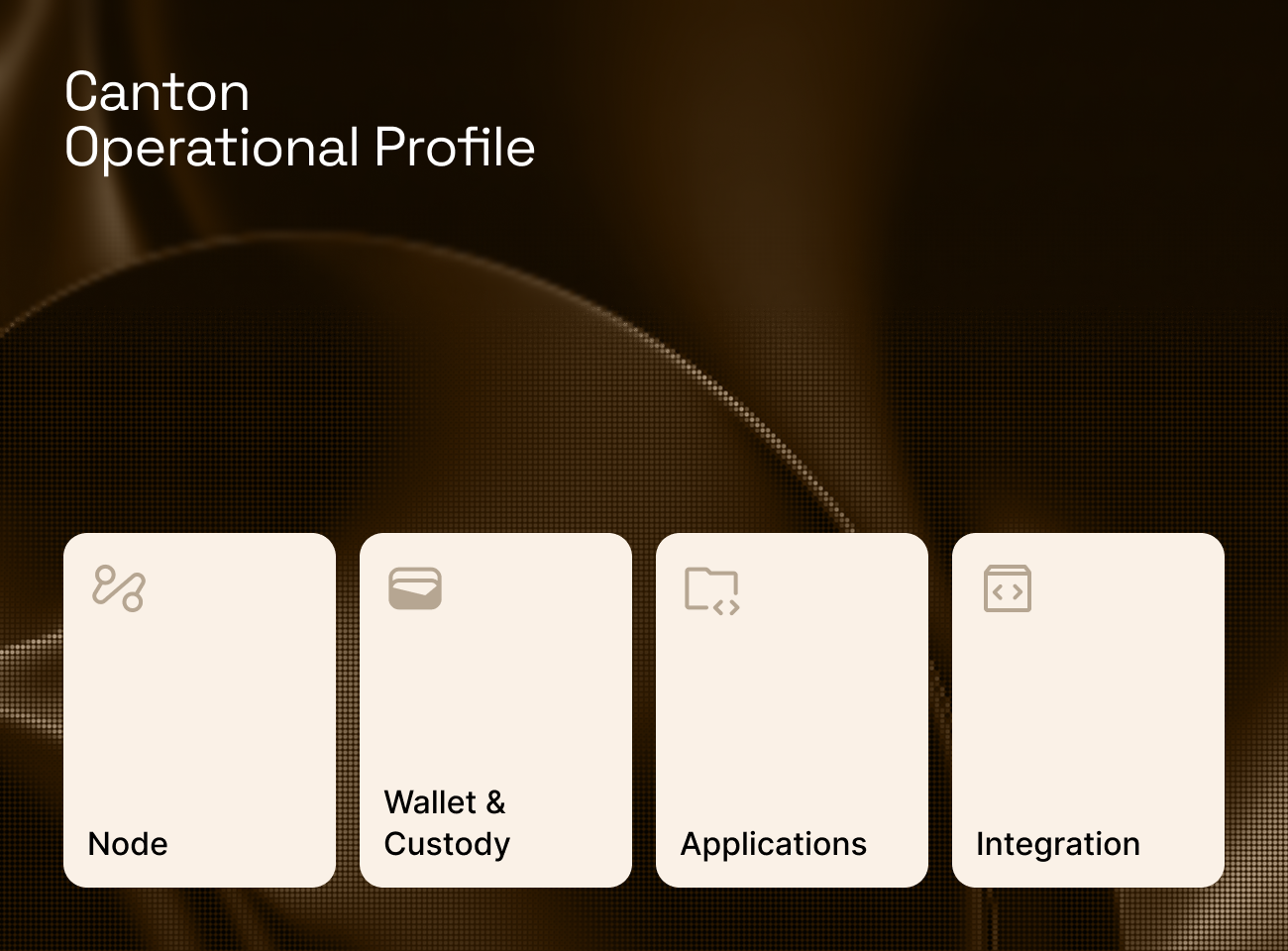
The moment an institutional asset moves on-chain in real volume, the operational profile changes:
- Your Canton node needs resilience, security, observability and support coverage that match the rest of your market infrastructure.
- Your Canton wallet and custody need institutional-grade controls and the ability to connect to your custody provider of choice, or integrate with your existing setup.
- Your applications need to be discoverable, distributable, and updateable across the network
- Your integration with existing systems needs to bridge legacy systems to the blockchain world
Each has a learning curve. Each matters to your assets going on-chain. Each is a place where the wrong setup becomes a blocker to going live.
The CatalyX Product Suite
CatalyX is built around a principle: the operational layer should be streamlined, not five vendor relationships.
Your Canton node. We currently operate more than 100+ active Canton validators through CatalyX Blockchain Manager, including roles as Super Validators on the Global Synchronizer. Multi-region deployment, 99.9% uptime targets, 24/7 expert support, cloud-agnostic as a default.
Your wallet, custody, and infrastructure. Institutional-grade wallet operations and custody integration with the qualified custody requirements and provenance of institutional digital assets demand.
Your applications. CatalyX Package Manager handles application discovery, distribution, and update coordination across the Canton Network. Validators receive a consistent application state. Counterparties find what they need to interoperate with.
Your integration. Catalyst Integration Manager bridges traditional financial messaging rails and DLT in live production, including the integration that powers the Ubyx clearing platform on Canton.
Expertise on demand. A dedicated Daml and Canton engineering team that builds, guides, and accelerates institutional projects on the network. The team contributes to the Splice codebase that powers the Global Synchronizer and operates a Daml Coding Assistant that accelerates institutions in building applications on Canton. When the standard stack is not enough, the team delivers what's missing - custom applications, bespoke integrations, and the specific capabilities production requires.

What we've learned operating this stack
Across the validators we operate at CatalyX, the patterns we see during the pilot-to-production transition are consistent. Resiliency requirements tighten. Load profiles change. Monitoring needs to be tightened. Security standards must match the rest of the institution's infrastructure. On-call coverage matters more than it did when the network was a sandbox. The application layer that worked at launch needs governance for ongoing updates. Integration with existing systems takes longer than the technical team expected. And once the network is live, keeping the setup updated and in line with Canton protocol changes requires a dedicated team of experts - not a project once, but an operating discipline.
The institutions that scale through this window will be the ones that treat the operational layer as a strategic decision rather than a delivery item addressed after the protocol question is settled. That inversion is what makes the period between now and October 2026 different from prior tokenization milestones.
Two recent milestones reinforce this. In November 2025, Broadridge and Société Générale's first US digital bond was settled on Canton with IntellectEU's CatalyX Blockchain Manager as the infrastructure layer. In February 2026, IntellectEU joined DTCC, LSEG, Euroclear, Citadel Securities, Tradeweb, Société Générale, and Archax in the Canton Industry Working Group's fourth round of cross-border intraday repo transactions on tokenised Gilts.
What this means between now and October
The path to production until October 2026 is going to test every part of the operational stack. The participants who scale through that window will be the ones who have built operational maturity before they needed it.
If you're in the DTCC working group and you're mapping these decisions, CatalyX is a one-stop platform ready to address the full lifecycle of your Canton participation. The foundation is institutional-grade node operations - both Validator and Super Validator roles on the Global Synchronizer - delivered under enterprise security, observability, and assurance controls. From that foundation, the platform extends across wallet deployment, application discovery and distribution, integration with your existing back-office and messaging infrastructure, and connectivity to your chosen institutional-grade custody provider.
We have been operating the Canton stack for seven years alongside major financial institutions, and remain at the table as participation in Canton scales toward October 2026.

Canton Network Transaction Fees Explained
Like most public blockchain networks, the Canton Network charges a fee for its use. Canton users pay two types of fees to use the Global Synchronizer (i.e. network): synchronizer traffic fees and holding fees.
Unlike most others, the synchronizer traffic fee is fixed at a certain amount of USD per MB of bandwidth or "synchronizer traffic". Although fees are quoted in USD, they are paid using the network's native utility coin: Canton Coin (CC). Currently, the price for 1MB of traffic on the Canton Network is $60 USD.
Besides the "synchronizer traffic fee", the Canton Network also charges a "holding fee". A holding fee is a fixed cost associated with maintaining an active Canton Coin record (UTXO) on the ledger.
Fee parameters, traffic pricing, limits, and related tokenomics settings are subject to change via a 2/3 majority of Super Validators and the Canton Improvement Proposal (CIP) process.
Synchronizer Traffic Fees
What Are They?
Global Synchronizer Traffic Fees represent the cost of consuming synchronization capacity or "bandwidth" on the Canton Network.
What Counts as Traffic?
Traffic refers to all messages from participants that must be sequenced on the network.
Most prominently, traffic is consumed by Daml workflows as part of the Canton transaction processing protocol, including confirmation requests (sent when a participant initiates a transaction) and confirmation responses (sent by participants who host stakeholders of a transaction). Not only custom Daml workflows count towards traffic spend - automated "built-in" workflows such as rewards collection also use traffic.
In addition to Daml workflow messages, participants also use traffic for submitting topology transactions (for example, allocating new parties or vetting newly uploaded DAR packages) and exchanging periodic ACS commitments to ensure synchronisation.
Importantly, traffic accounting is "by participant": all parties hosted on the same participant share the same traffic balance.
The Base Rate: Everyone Gets Free Traffic
Every participant receives a limited amount of synchronizer traffic free of charge via a base-rate allowance. The base rate is defined as a burst amount over a time window, so that even when fully depleted, the available base-rate traffic balance recovers fully after a "window"-long period of inactivity.
Usage beyond this allowance consumes paid traffic (also called "extra traffic"), which is charged by burning Canton Coin. The base rate traffic balance is always consumed first; extra traffic is only drawn down when the base rate is fully depleted. When neither base rate nor extra traffic balance is available, the sequencer will deny further submission attempts until either the base rate recovers or extra traffic is topped up.
Traffic Pricing Parameters
The current synchronizer traffic parameters are recorded in the global AmuletRules contract and can be retrieved via the Scan API using the /api/scan/v0/amulet-rules endpoint.
For example, this returns a JSON object containing:
{
"baseRateTrafficLimits": {
"burstAmount": "400000",
"burstWindow": { "microseconds": "1200000000" }
},
"extraTrafficPrice": "60.0",
"readVsWriteScalingFactor": "4",
"minTopupAmount": "200000"
}
To explain these fields:
- baseRateTrafficLimits defines the free tier. Validators can use up to burstAmount bytes within a burstWindow time window without incurring fees. The free balance is restored periodically and always reaches its maximum after a full burstWindow of inactivity.
- extraTrafficPrice is the price of paid traffic beyond the free tier, denominated in USD per MB. The price is charged in Canton Coin as per the current USD/CC exchange rate, which is determined by SVs via median voting and recorded on current OpenMiningRound contracts obtainable from Scan.
- readVsWriteScalingFactor specifies the additional traffic charged for delivering a message to each recipient (in basis points per 10,000). For example, at a factor of 4, a 1 MB message with 10 recipients draws 1,000,000 x (1 + 10 x 0.004) = 1,040,000 bytes from the sending participant's balance.
- minTopupAmount is the minimum amount of traffic that must be bought in a single purchase, protecting SVs from disproportionate overhead from very small top-ups.
The Burn Mechanics
To "buy" traffic, Canton Coin is burned by the participant and converted into extra traffic balance. On-ledger MemberTraffic contracts track each validator's traffic state and are updated atomically whenever CC is spent for buying traffic. SVs then update the in-sequencer traffic state based on the MemberTraffic state they observe on the ledger, ensuring paid traffic fees are translated into actual traffic balance increases.
The validator app contains built-in top-up automation that automatically buys traffic to meet pre-configured throughput needs. Operators configure a target throughput (bytes per second) and a minimum top-up interval (seconds). Note that traffic is non-transferable - traffic balances cannot be converted back to Canton Coin.
How This Supports the Burn-Mint Equilibrium
Canton Coin employs a burn-mint equilibrium mechanism. Instead of paying fees directly to network infrastructure providers, all fees for using Canton Coin and for creating a traffic balance on the Global Synchronizer are burned by the user who submits the transaction. In return for operating applications and network infrastructure, providers can mint new Canton Coins. Thus, the usage fee from the user to the provider is indirect via the burn-and-mint mechanism.
This creates a self-correcting price mechanism: as more participants use the network and burn CC for traffic, supply decreases, which tends to increase the CC/USD rate, which in turn decreases the number of CC needed per MB - and vice versa. You can read more about this in the Canton Coin Whitepaper.
Holding Fees
A holding fee is a fixed cost associated with maintaining an active Canton Coin record (UTXO) on the ledger. It is computed per round but not charged continuously to active participants.
Following CIP-0078, holding fees no longer apply to Canton Coin transfers. Instead, they accrue notionally over time and are only enforced if Super Validators explicitly expire a coin whose accrued holding fees meet or exceed its coin amount. When a coin is expired, the entire coin amount is charged as holding fees, the coin amount is burned, and the coin contract is archived.
This mechanism exists to limit the lifetime of long-lived, low-value ("dust") coin contracts and to bound ledger growth. It does not affect actively used coins or normal transaction flows.
Earning Rewards by Transacting on the Network: CIP-0104 Explained
One of the most significant recent developments in Canton Network tokenomics is CIP-0104: Traffic-Based App Rewards, approved on February 12, 2026.
CIP-0104 proposes to improve the quality of app reward incentives by removing featured app markers and instead basing an app's rewards on the actual traffic spent on transactions that change the state managed by the app. This is achieved by measuring traffic spent directly on the Global Synchronizer using sequencer and mediator data.
In the post-CIP-0104 model, application rewards are derived directly from the actual Global Synchronizer traffic spent on successful confirmation requests involving a featured application. This transition replaces governance-defined marker issuance with a protocol-measured, traffic-weighted model, ensuring rewards are directly aligned with measurable economic activity on the network.
In practical terms: the more meaningful traffic your application drives on the network, the more Canton Coin your application can earn back through minting - creating a direct and transparent link between usage and reward.
This CIP also proposes to make protocol-conformant confirmation responses free, so that validator nodes only pay for the submission of transactions by their users - an action validators can explicitly gate and charge for if required. This enables validator operators to manage traffic costs and fosters decentralization of apps and wallets.
Key CIPs That Shape the Fee Model
The Canton Network fee structure has been revised through the CIP governance process. Changes require approval by a 2/3 supermajority of Super Validators and apply only to future activity.
Running a Canton Validator
Understanding the fee model is useful. Managing traffic balances, automating top-ups, and monitoring validator health across production deployments is a different challenge.
CatalyX Blockchain Manager, built by IntellectEU as a founding member of the Canton Foundation, provides the infrastructure management layer for Canton validator operators - from node deployment to operational tooling. Whether you're running a single validator node or managing fleet-scale infrastructure, the platform handles the operational overhead so your team focuses on building.
Interested in Canton Network participation? Explore CatalyX Blockchain Manager and reach out to the IntellectEU team to discuss your setup.
Frequently Asked Questions