From Pilot to Production: Building on Canton Network for Tokenized Assets
DTCC's announcement on May 4 set a clear path. Limited production trades in July 2026. Full tokenization service launch in October 2026. More than fifty participants in the DTCC Industry Working Group are now moving from design discussions into operational reality.
This is what production actually asks of you. And how a one-stop operational layer answers it.
What changes between pilot and production
A pilot can run on a single validator with relaxed availability targets. A handful of test counterparties. One settlement workflow. Curated data.
Production tokenized assets cannot.
The moment an institutional asset moves on-chain in real volume, the operational profile changes:
- Your Canton node needs resilience, security, observability and support coverage that match the rest of your market infrastructure.
- Your Canton wallet and custody need institutional-grade controls and the ability to connect to your custody provider of choice, or integrate with your existing setup.
- Your applications need to be discoverable, distributable, and updateable across the network
- Your integration with existing systems needs to bridge legacy systems to the blockchain world
Each has a learning curve. Each matters to your assets going on-chain. Each is a place where the wrong setup becomes a blocker to going live.
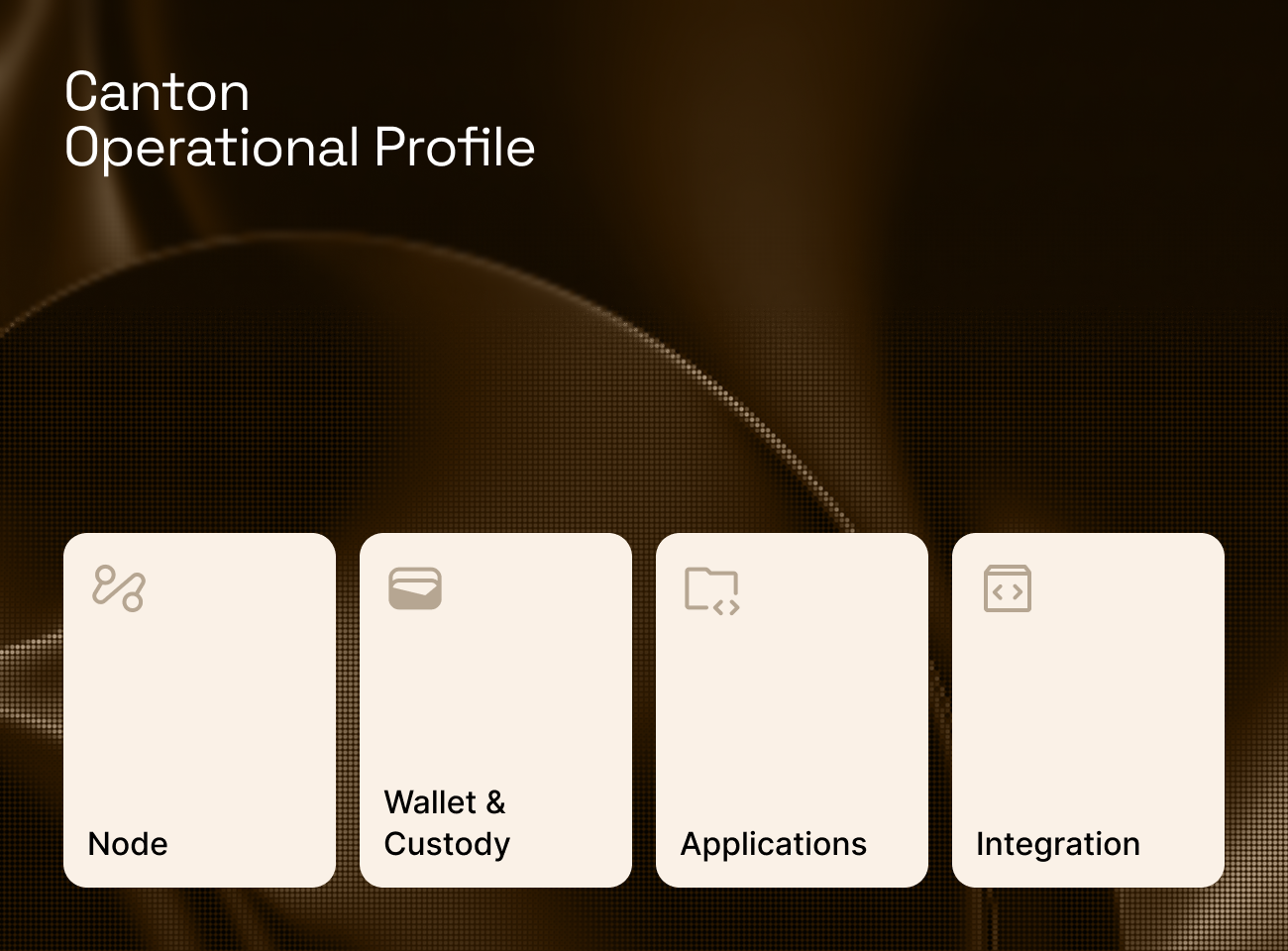
The CatalyX Product Suite
CatalyX is built around a principle: the operational layer should be streamlined, not five vendor relationships.
Your Canton node. We currently operate more than 100+ active Canton validators through CatalyX Blockchain Manager, including roles as Super Validators on the Global Synchronizer. Multi-region deployment, 99.9% uptime targets, 24/7 expert support, cloud-agnostic as a default.
Your wallet, custody, and infrastructure. Institutional-grade wallet operations and custody integration with the qualified custody requirements and provenance of institutional digital assets demand.
Your applications. CatalyX Package Manager handles application discovery, distribution, and update coordination across the Canton Network. Validators receive a consistent application state. Counterparties find what they need to interoperate with.
Your integration. Catalyst Integration Manager bridges traditional financial messaging rails and DLT in live production, including the integration that powers the Ubyx clearing platform on Canton.
Expertise on demand. A dedicated Daml and Canton engineering team that builds, guides, and accelerates institutional projects on the network. The team contributes to the Splice codebase that powers the Global Synchronizer and operates a Daml Coding Assistant that accelerates institutions in building applications on Canton. When the standard stack is not enough, the team delivers what's missing - custom applications, bespoke integrations, and the specific capabilities production requires.

What we've learned operating this stack
Across the validators we operate at CatalyX, the patterns we see during the pilot-to-production transition are consistent. Resiliency requirements tighten. Load profiles change. Monitoring needs to be tightened. Security standards must match the rest of the institution's infrastructure. On-call coverage matters more than it did when the network was a sandbox. The application layer that worked at launch needs governance for ongoing updates. Integration with existing systems takes longer than the technical team expected. And once the network is live, keeping the setup updated and in line with Canton protocol changes requires a dedicated team of experts - not a project once, but an operating discipline.
The institutions that scale through this window will be the ones that treat the operational layer as a strategic decision rather than a delivery item addressed after the protocol question is settled. That inversion is what makes the period between now and October 2026 different from prior tokenization milestones.
Two recent milestones reinforce this. In November 2025, Broadridge and Société Générale's first US digital bond was settled on Canton with IntellectEU's CatalyX Blockchain Manager as the infrastructure layer. In February 2026, IntellectEU joined DTCC, LSEG, Euroclear, Citadel Securities, Tradeweb, Société Générale, and Archax in the Canton Industry Working Group's fourth round of cross-border intraday repo transactions on tokenised Gilts.
What this means between now and October
The path to production until October 2026 is going to test every part of the operational stack. The participants who scale through that window will be the ones who have built operational maturity before they needed it.
If you're in the DTCC working group and you're mapping these decisions, CatalyX is a one-stop platform ready to address the full lifecycle of your Canton participation. The foundation is institutional-grade node operations - both Validator and Super Validator roles on the Global Synchronizer - delivered under enterprise security, observability, and assurance controls. From that foundation, the platform extends across wallet deployment, application discovery and distribution, integration with your existing back-office and messaging infrastructure, and connectivity to your chosen institutional-grade custody provider.
We have been operating the Canton stack for seven years alongside major financial institutions, and remain at the table as participation in Canton scales toward October 2026.
Frequently Asked Questions
A Canton Network validator is a node that participates in the network by executing Daml smart contracts and recording transactions on behalf of the parties it hosts.
CatalyX is a tokenization platform and operational layer for institutions deploying tokenized assets and real world assets on Canton Network. The platform covers Canton node operations, institutional-grade wallet and custody integration, application distribution via CatalyX Package Manager, and integration with existing back-office and messaging infrastructure.
CatalyX Package Manager is a governed registry that handles Canton application discovery, distribution, and update coordination across the network. Validators receive a consistent application state. Counterparties find what they need to interoperate with. It removes the operational overhead of managing Canton application packages across multiple parties.
CatalyX delivers institutional-grade wallet operations and blockchain custody integration on Canton. The platform connects to your custody provider of choice or integrates with your existing setup, meeting the qualified custody requirements and provenance that institutional digital assets demand.
Production tokenized assets on Canton Network require institutional-grade node resilience and observability, security controls that match existing market infrastructure, 24/7 expert support coverage, governed application distribution, and ongoing alignment with Canton protocol changes. CatalyX delivers all of this as a managed operational layer, so institutions don't have to assemble five vendor relationships to go live.

.png)

.webp)

%201.svg)